
Energiezuinige AI: minder verbruik, zelfde prestaties
/
Energiezuinige AI: minder verbruik, zelfde prestaties
AI-modellen worden steeds krachtiger, maar vaak ook steeds groter. Grote modellen vereisen veel rekenkracht, geheugen en energie - wat ze minder geschikt maakt voor gebruik op edge devices, maar ook realtime computervisie applicaties zoals de Howest Virtual Mirror. Gelukkig zijn er technieken om AI-modellen te verkleinen zonder de accuraatheid ervan te verlagen. In deze blogpost bespreken we de belangrijkste optimalisatietechnieken: quantisatie, pruning en kennisdistillatie. We bekijken ook welke tools je kunt gebruiken en hoe groot de impact kan zijn.

Main section
Kerngegevens
/
Van 32-bit naar 8-bit? Zelfde model, 4x kleiner.
/
Pruning = snellere inference
/
Klein model, grotere intelligentie: dat is distillatie.
Drie technieken
1. Quantisatie
Inleiding
Binnenin een AI model zitten er miljoenen tot miljarden kommagetallen - ook wel “gewichten” en “activaties” genoemd. Elk getal neemt typisch 32 bits (nullen en enen) geheugen in beslag.
Voor een computer zijn kommagetallen eigenlijk zeer lastig om mee te rekenen. Één zo’n berekening duurt uiteraard slechts enkele nanoseconden (of minder), maar door de enorme hoeveelheid ervan loopt deze vertraging zo hoog op dat het uiteindelijke model er seconden tot minuten over doet om data te verwerken.
Voorbeeld: elk sub-woord dat door GPT-4 genereert wordt moet door 1 tot 2 biljoen (trillion) parameters verwerkt worden. Beeld je maar in hoeveel berekeningen nodig zijn om een volledige tekst te genereren. Dit is de reden dat er voor AI zo’n grote nood is aan krachtige GPU’s. (https://en.wikipedia.org/wiki/GPT-4)
Bestaand model quantiseren
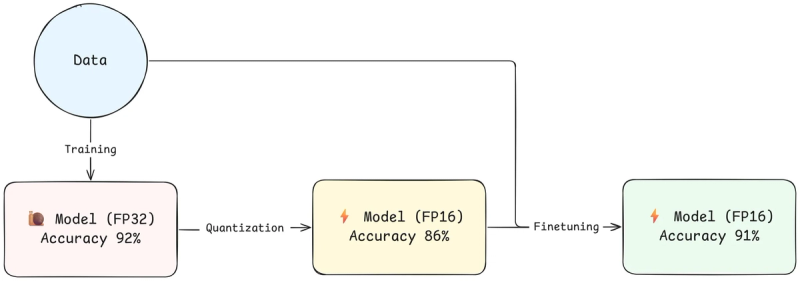
Post-training quantization (PTQ) is het proces waarbij de getallen in een reeds getraind model worden omgezet van 32-bit floating-point (FP32) naar een lagere precisie, zoals 16-bit (FP16) of zelfs 8-bit integers (INT8). Concreet heb je dan minder cijfers na de komma, of zelfs helemaal geen komma meer.
Impact:
- Tot 4x verkleining van modelgrootte (van FP32 naar INT8).
- 2x tot 4x snelheidsverbetering.
- Vaak minimaal verlies in nauwkeurigheid (hangt sterk af van type model).
Wat men vaak doet is het gequantiseerde model nog eens kort hertrainen of finetunen. Dikwijls verhoogt dit de accuraatheid opnieuw naar het oorspronkelijke niveau van het niet-gequantiseerde model.
Gequantiseerd trainen
Een tweede mogelijkheid is Quantized Aware Training (QAT). Hierbij traint men het model met reeds afgeronde getallen om het quantisatie-effect te simuleren. Typisch levert dit nog betere resultaten op dan PTQ, maar je moet het op voorhand in rekening brengen of je model volledig hertrainen.
Voorbeelden: op Ollama kan je van sommige taalmodellen - zoals de gemma3 familie - ook QAT-varianten terugvinden die tot 3 keer sneller zijn (https://ollama.com/library/gemma3:4b-it-qat). Ook van computervisie modellen zoals YOLO bestaan PTQ-varianten zoals YOLOv8-Detection-Quantized (https://huggingface.co/qualcomm/YOLOv8-Detection-Quantized).
Frameworks
Er bestaan verschillende Python-libraries die functies bevatten om jouw model te quantiseren:
- Gebruik de “tf.lite.Optimize” library voor TensorFlow modellen.
- Gebruik de “torch.ao.quantization” library voor PyTorch modellen. Dit is een onderdeel van de PyTorch Architecture Optimization library.
- Gebruik “onnxruntime.quantization” library voor modellen die geëxporteerd zijn als een gestandaardiseerd ONNX formaat.
- Ook Hugging Face’s Optimum library beschikt over quantisatie mogelijkheden voor ONNX modellen en Intel-systemen.
2. Pruning
Pruning verwijdert elementen uit het model die weinig bijdragen aan het uiteindelijke resultaat ervan. Het verminderen van overbodige parameters verkleint het aantal berekeningen die moeten gemaakt worden waardoor het model sneller zal zijn.
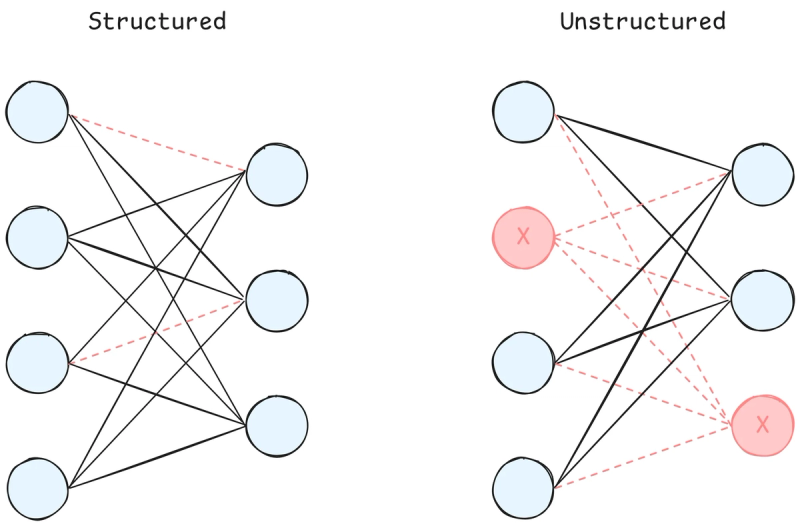
Er bestaan twee soorten pruning:
- Niet-gestructureerde pruning: verwijderen van individuele gewichten of verbindingen.
- Gestructureerde pruning: verwijderen van hele filters, neuronen of lagen.
Ook hier kan je het model hertrainen of finetunen na het prunen om het kleine verlies in accuraatheid te compenseren.
Frameworks
Er bestaan Python-libraries die functies bevatten om jouw model te prunen:
- Gebruik de “torch.nn.utils.prune” library voor PyTorch modellen.
- Gebruik de “tensorflow_model_optimization.sparsity.keras” library voor TensorFlow modellen.
- Ook Hugging Face’s Optimum library beschikt over pruning mogelijkheden voor Intel-systemen.
3. Kennisdistillatie
Kennisdistillatie is een techniek waarbij een klein model wordt getraind om de output van een groot, krachtig model te imiteren. Men beschrijft dit vaak als een student-leerkracht relatie.
Het leerkracht-model werd getraind door te leren uit grote hoeveelheden data. Het student-model daarentegen, wordt enkel getraind wordt op de output van een (reeds getraind) leerkracht-model en komt eigenlijk nooit in aanraking met de oorspronkelijke data.

In de praktijk blijkt dat student-modellen vaak bijna dezelfde nauwkeurigheid kunnen bereiken als het leerkracht-model terwijl ze veel kleiner en sneller zijn.
Voorbeeld: Het Chinese DeepSeek ontwikkelt gedistilleerde taalmodellen zoals DeepSeek-R1-Distill-Qwen-7B (https://huggingface.co/deepseek-ai/DeepSeek-R1-Distill-Qwen-7B). Een ouder succesverhaal van distillatie is TinyBERT. Die is ruim 7 keer kleiner en 9 keer sneller dan het oorspronkelijke BERT terwijl het slechts een daling van ±3% heeft in nauwkeurigheid (https://arxiv.org/pdf/1909.10351).
Bottom section
Samenvatting
Optimalisatietechnieken zoals quantisatie, pruning en distillatie kunnen heel voordelig zijn op vlak van snelheid, energieverbruik, kostprijs en hardware-eisen. Zeker in toepassingen zoals computervisie en taalmodellen maken ze het verschil.
Het vergt wel enige tijd om mee te experimenteren en het verlies in accuraatheid te beoordelen en/of te compenseren. Deze extra ontwikkelingstijd kan afhankelijk van de schaal van het project al dan niet de moeite waard zijn. Daarnaast zijn niet alle besproken technieken even nuttig op verschillende hardware of type modellen.